
Cellular Energy & NAD+ (demo)
By The Taste for Life Staff
This content originally appeared on tasteforlife.com
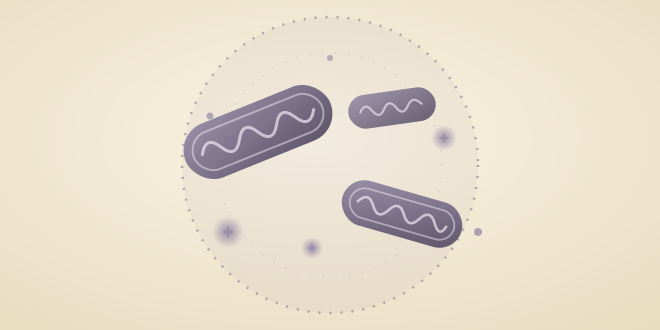
Every heartbeat, every thought, every deep breath is paid for in a single currency your cells mint around the clock: energy. And like any currency, it can quietly run short.
For years, "energy" supplements mostly meant caffeine and sugar—a quick loan against tomorrow. The conversation in 2026 has moved somewhere far more interesting: how to support the energy your cells actually make, from the inside out.
At the center of that conversation is a molecule with an unglamorous name and an outsized job—NAD+.
What Is NAD+?
NAD+ (nicotinamide adenine dinucleotide) is a coenzyme found in every living cell. If that sounds abstract, picture a tiny delivery shuttle that hauls electrons from one place to another so that the work of life can get done.
It has three especially important jobs:
-
Turning Food into Fuel
Deep inside your mitochondria, NAD+ helps convert the food you eat into ATP—the ready-to-use fuel that powers nearly everything your body does. No NAD+, no spark.
-
Repairing DNA
Your cells take on small genetic dings every day. A family of repair enzymes called PARPs draws on NAD+ to patch that damage before it accumulates.
-
Switching On "Longevity" Genes
A set of proteins called sirtuins—often nicknamed the body's longevity genes—simply cannot do their work without NAD+. They help regulate inflammation, metabolism, and the cell's own housekeeping.
Why NAD+ Fades with Age
Here is the catch. NAD+ does not hold steady over a lifetime. Research suggests our levels can fall to roughly half of their youthful peak by middle age.
It is a bit like a bank account being drawn down faster than it is refilled. Production slows with the years, and at the same time an enzyme called CD38—which rises alongside age-related inflammation—consumes NAD+ more aggressively. Less coming in, more going out.
What That Decline Feels Like
Low cellular energy rarely announces itself dramatically. It tends to show up as the slow stuff: afternoons that drag, workouts that take longer to bounce back from, a memory that feels a half-step behind.
Declining NAD+ has been associated with many of the hallmarks of aging. It is worth being clear-eyed here: association is not the same as proof, and no single molecule turns back the clock. But the science linking NAD+ to how well we age is genuinely compelling.
Mitochondria: Your Cellular Power Plants
NAD+ never works alone. Most of its energy magic happens inside the mitochondria—the tiny power plants tucked into nearly every cell, sometimes hundreds or thousands of them in a single hard-working muscle cell.
As we age, some mitochondria grow sluggish or damaged, like aging machinery on a factory floor. The goal is not simply to have more of them, but to keep the ones you have running clean.
Mitophagy: Cellular Spring Cleaning
The body has an elegant solution: it recycles worn-out mitochondria through a process called mitophagy. Think of it as a night-shift cleanup crew that hauls away the broken-down equipment so fresh machinery can take its place.
Keeping that cleanup crew on the job has become one of the most active areas in longevity science—and the inspiration behind a new wave of supplements.
Replenishing the Spark
You cannot simply swallow NAD+ and expect much: the molecule is too large and unstable to absorb intact in meaningful amounts. So the focus has shifted to its precursors—the raw materials your body uses to build NAD+—and to the nutrients that support mitochondria directly.
-
NAD+ Precursors (NMN and NR)
The two most-discussed players are NMN (nicotinamide mononucleotide) and NR (nicotinamide riboside)—both forms of vitamin B3. The body converts them, step by step, into NAD+.
Early human trials show these precursors can reliably raise NAD+ levels in the blood. What that means for energy, fitness, and aging over the long run is still being studied. Their older B3 cousins, niacin and niacinamide, have supported this same pathway for decades.
-
Urolithin A
This compound forms when gut bacteria break down ellagitannins—the antioxidants found in pomegranates, walnuts, and certain berries. It has drawn attention for its ability to support mitophagy, that cellular spring cleaning, with promising early studies in muscle strength and endurance.
Here is the wrinkle: not everyone's gut produces urolithin A efficiently, which is exactly why it is now offered as a stand-alone supplement.
-
CoQ10 and PQQ
Two longtime favorites on the supplement shelf. CoQ10 helps ferry electrons along the mitochondrial energy chain, and levels tend to dip with age and with certain medications, including statins. PQQ is being explored for its potential to support the formation of new mitochondria.
-
Spermidine and Fisetin
Two plant compounds rounding out the 2026 longevity aisle. Spermidine (found in wheat germ, aged cheese, and soy) is studied for its role in autophagy, and fisetin (a pigment in strawberries) for its effect on worn-out "senescent" cells. The research is early but worth watching.
Beyond the Bottle
Supplements are only part of the story. Some of the most reliable ways to protect cellular energy cost nothing at all.
-
Move Your Body
Exercise is one of the most potent ways known to build new mitochondria and naturally nudge NAD+ upward. A brisk daily walk counts.
-
Give Your Cells a Rest
Sensible gaps between meals appear to trigger the body's cellular cleanup machinery. You do not need an extreme regimen—simply not grazing from morning to midnight is a start.
-
Protect Your Sleep
Much of the body's repair work happens overnight. Short-changing sleep short-changes the very systems you are trying to support.
-
Mind the Basics
Excess alcohol, a steady stream of sugar, and unprotected sun all draw down your reserves. Easing up on them frees energy for everything else.
A Thoughtful Approach
The longevity aisle has grown crowded, and quality varies widely from one label to the next. As with any supplement, more is not automatically better.
Talk with your healthcare provider before starting something new—especially if you take medication, are pregnant or nursing, or manage a chronic condition. Begin with the basics, choose brands that test their products, and remember that cellular energy is a long game.
The body has been making its own energy, beautifully, for your whole life. The aim is simply to give it the raw materials and the rest it needs to keep doing so—one small, steady step at a time.